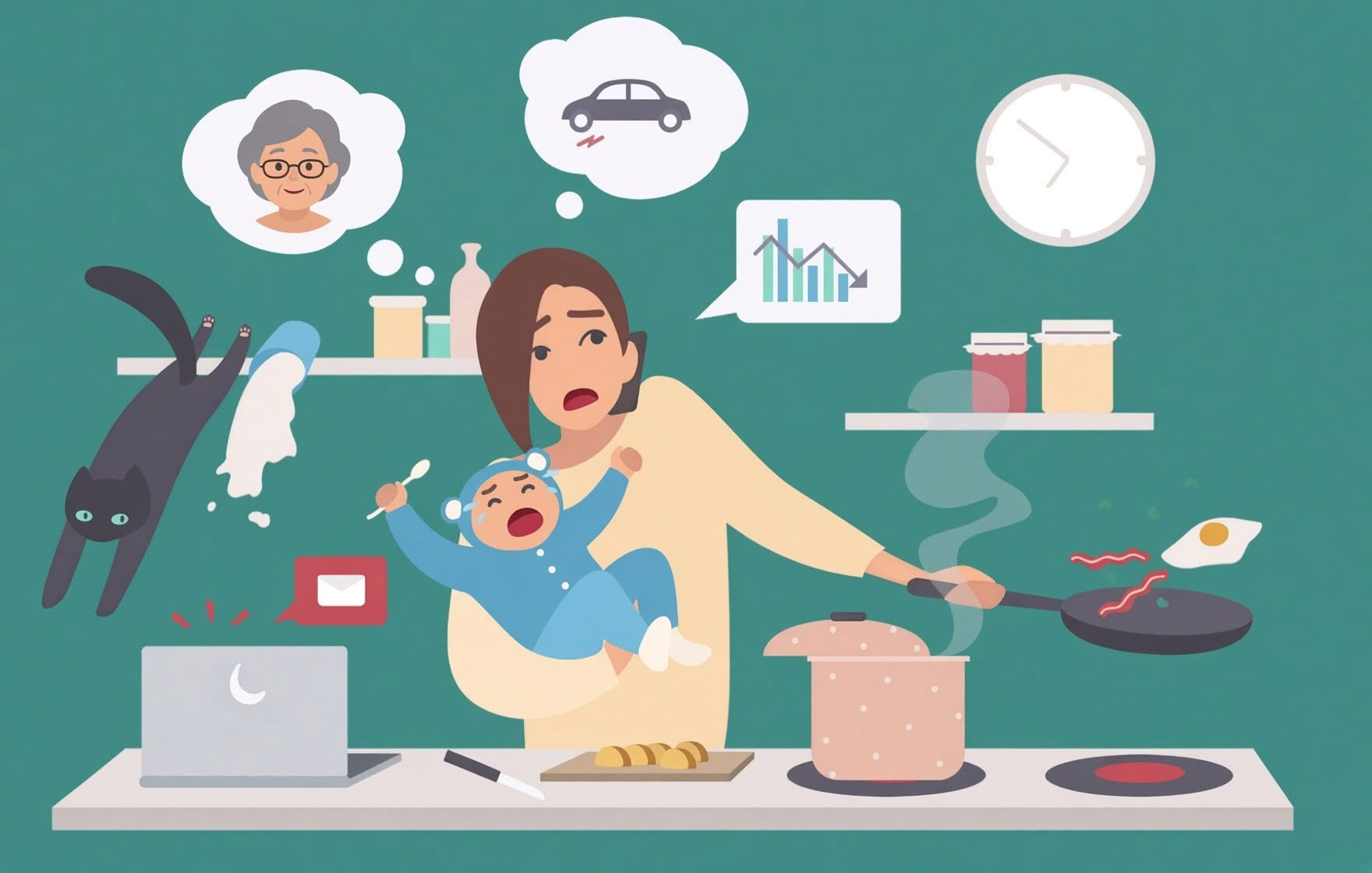
It’s a typical day in my office.
Across from me sits a well-put-together woman in her forties or early fifties. She will often say some version of this: “In the morning I’m a mother. At midday I’m an employee. In the afternoon I’m a daughter. In the evening I can’t stand being anything.”
She isn’t crying. She isn’t particularly sad. She is resigned. She’s describing a day that has been repeating itself for months, or years.
She belongs to the Sandwich Generation.
The term was first coined in the early 1980s by researchers Dorothy Miller and Elaine Brody. It describes middle-aged people who, while raising their own underage children, are also expected to care for their ageing parents: financially, practically, emotionally. Usually all three at once.
While the phenomenon is not new, what has changed in recent years is the duration of the overlap. Parents live longer. Life expectancy has grown faster than healthy life expectancy; the years we get with our parents are the ones that need us most. We marry later. We have children later. In the United Kingdom alone, more than a million people find themselves in this position. One in three middle-aged Europeans is, demographically, “in the middle”. Here in Greece, with parents living longer and children leaving home after the age of 30 (a polite way of saying they don’t really leave at all), the overlap isn’t a season. It’s a decade.
It takes a huge mental toll. Recent studies from University College London show it plainly in the numbers: once you enter dual care, mental health deteriorates, especially when the care exceeds twenty hours a week. This deterioration does not reverse quickly. The ONS figures put symptoms of depression or anxiety at 31 per cent among sandwich carers against 24 per cent in the general population, and diagnosed depression at 19 per cent against 13 per cent. Women carry more of it.
By now, I recognise this pattern when it walks through the door. Mostly women in their forties and early fifties. Men come too, fewer of them, and usually later. Deep exhaustion they dismiss as “just being tired” (tiredness is what gets better on a Sunday). Guilt they never call guilt. A sense that something is always left out. They haven’t given it a name. They will say “That’s life.” Or, “I just have to push through.”
Silence is not always a choice. Very often it is the only way to keep going.
The load is existential, too. You are still your parents’ child and at the same time the adult who has to decide for them. You are a parent who needs to be present while part of you is texting with your father’s caregiver. You are an employee asking for leave for reasons that do not fit neatly into an email. You are a spouse, and by the end of the day there is nothing left to give. Time for yourself becomes a luxury you almost feel ashamed to ask for. Care takes the whole day. Quiet disappears.
I see people living in permanent readiness. People who have stopped asking “what do I need?” because the question itself sounds almost ridiculous inside a day like this. Silence becomes habit, and habit becomes a way of being.
There are no easy solutions, but there are small adjustments that change the quality of the day. Asking for help. Accepting that you cannot be equally good at every front at the same time (you cannot; the fact that you keep trying does not make it possible). Keeping one hour a week that belongs only to you. Not for “self-care.” So that you can hold.
And the essential point: exhaustion is not a personal failure. People did not suddenly become less resilient. The expectations and the demands of life became overwhelming. The Sandwich Generation is carrying two full loads of care at once, for years, in a society that does not recognise this and still treats this type of work as the sort of thing that just happens.
It doesn’t just happen.
Someone does it.
If that person is you, say it out loud to one person today. Your spouse, your best friend, your sibling, someone you trust. Use the words and compassion you would for a person you love who found themselves in your place. It won’t solve anything immediately, but articulating it will at least remove the most expensive part: the loneliness that comes with it.
Sources
Miller, D. (1981). "The 'Sandwich' Generation: Adult Children of the Aging." Social Work 26(5): 419–423
University College London (Public Health, 2025)
Office for National Statistics, Sandwich carers UK (November 2024)
Eurostat, "When do young people in the EU leave home?" (23 September 2025, 2024 data)